

If you keep your own books in QuickBooks Online, fall is the best time to get the file in shape — not January, when year-end and tax season take over.
Working through a short checklist in October and November gives you December to tidy remaining items before year-end. That means fewer surprises in the spring, cleaner GST reporting, and a smoother hand-off if someone else prepares your personal or business tax return.
Below: why fall matters, a practical QBO checklist, a simple countdown, and key CRA dates for calendar-year businesses in Canada.
Why do this in the fall?
- ✓ There is still time to fix coding, reconciliations and GST issues before December 31.
- ✓ January onward fills quickly with year-end and tax work — for you and for most accountants.
- ✓ A cleaner QBO file means fewer questions later and a clearer picture of how the year actually went.
Your fall QBO checklist
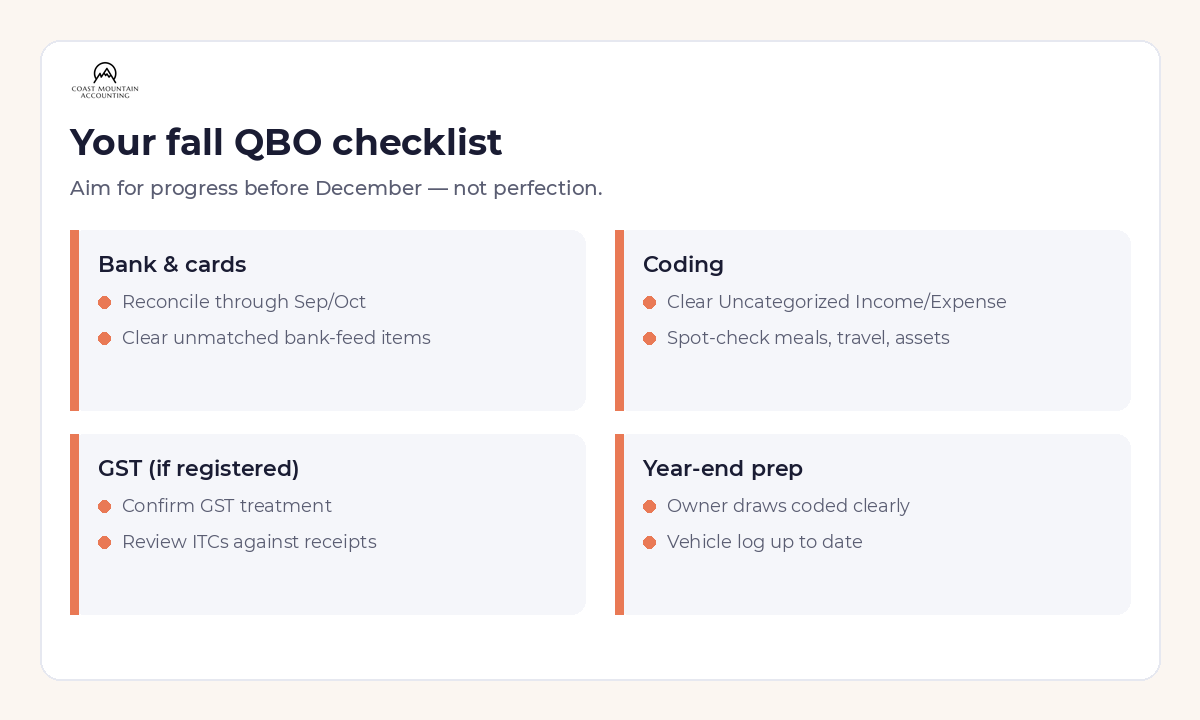
Aim to get through as much of this as you can in October and November (reconcile at least through September or October). Perfect is not the goal — progress before year-end is.
💳 Bank and credit cards
- ✓ Reconcile every business bank and credit card account through September or October.
- ✓ Clear lingering unmatched or “for review” items in the bank feed.
🗂️ Uncategorized and miscoded transactions
- ✓ Clear Uncategorized Income and Uncategorized Expense (and any catch-all “Ask my accountant” buckets).
- ✓ Spot-check categories that often go wrong: meals, travel, supplies vs. assets, and personal spending paid from the business.
📎 Receipts and support
- ✓ Attach or file receipts for larger purchases — equipment, tools, computers and vehicle-related costs.
- ✓ Note anything unusual this year: a big one-time job, a new loan, a grant or a large refund.
👤 Owner draws and personal items
- ✓ Code owner draws / personal withdrawals clearly so they are not sitting in expense accounts.
- ✓ Move (or flag) personal expenses paid from the business out of expense categories.
🧾 GST/HST (if you are registered)
- ✓ Confirm sales and purchases have the right GST treatment.
- ✓ Check that input tax credits look reasonable against your receipts.
- ✓ Note your reporting period (monthly, quarterly or annual) so year-end lines up with QBO.
🏠 Vehicle and home office
- ✓ Bring your vehicle log up to date (business km vs. total km) for the year so far.
- ✓ Note home-office square footage and any changes to rent, utilities or internet if you claim a workspace.
📬 Customers, suppliers and open items
- ✓ Review open invoices and bills. Follow up on anything unlikely to be collected or paid.
- ✓ Confirm customer deposits, retainers or gift cards sit in the right liability accounts, not in income by mistake.
👥 Payroll and slips (if you have employees or contractors)
- ✓ Confirm payroll is posted through the current month.
- ✓ Keep T4 / T4A information handy for the February slip deadline.
You do not need every item finished before December — use the list to prioritize what matters most for your business.
Fall countdown
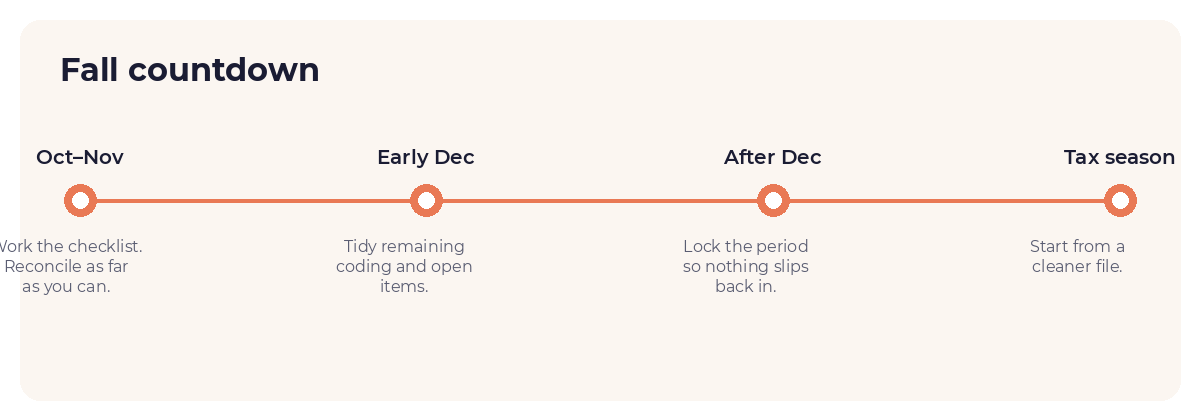
October–November
Work through the checklist; reconcile as far as you can.
Early December
Tidy remaining coding and open items.
After December is reconciled
Lock the period so nothing slips back in.
Tax season
Start from a cleaner file, whether you file yourself or work with an accountant.
Key CRA dates to keep in mind
These are the usual rules for self-employed individuals with a calendar year. Always confirm your own dates in your CRA account — weekends and CRA-recognized holidays can shift a due date to the next business day.
Your T1 (personal tax return)
If you (or your spouse or common-law partner) are self-employed, you generally have until June 15 to file. Any balance owing is still due April 30. Filing later does not move the payment date.
GST/HST — annual filers who are sole proprietors
If you are a sole proprietor, your fiscal year-end is December 31, and you had business income for the year, GST/HST payment is due April 30 and the return is due June 15. Monthly and quarterly filers: return and payment are due one month after each period ends.
T4 / T4A information returns
If you issue slips, they are due by the last day of February following the calendar year.
In British Columbia you charge GST on taxable sales; PST is separate with the Province. The CRA still uses “GST/HST” as the umbrella term on the federal return.
Questions?
Coast Mountain prepares T1 personal tax returns and GST returns for business owners — if you’d like help once your books are in shape, contact us.
If you have questions about getting your QuickBooks Online file ready for year-end, we are happy to help.
QuickBooks® and ProAdvisor® are registered trademarks of Intuit Inc. Used with permission. Coast Mountain Accounting is an Intuit QuickBooks ProAdvisor.